
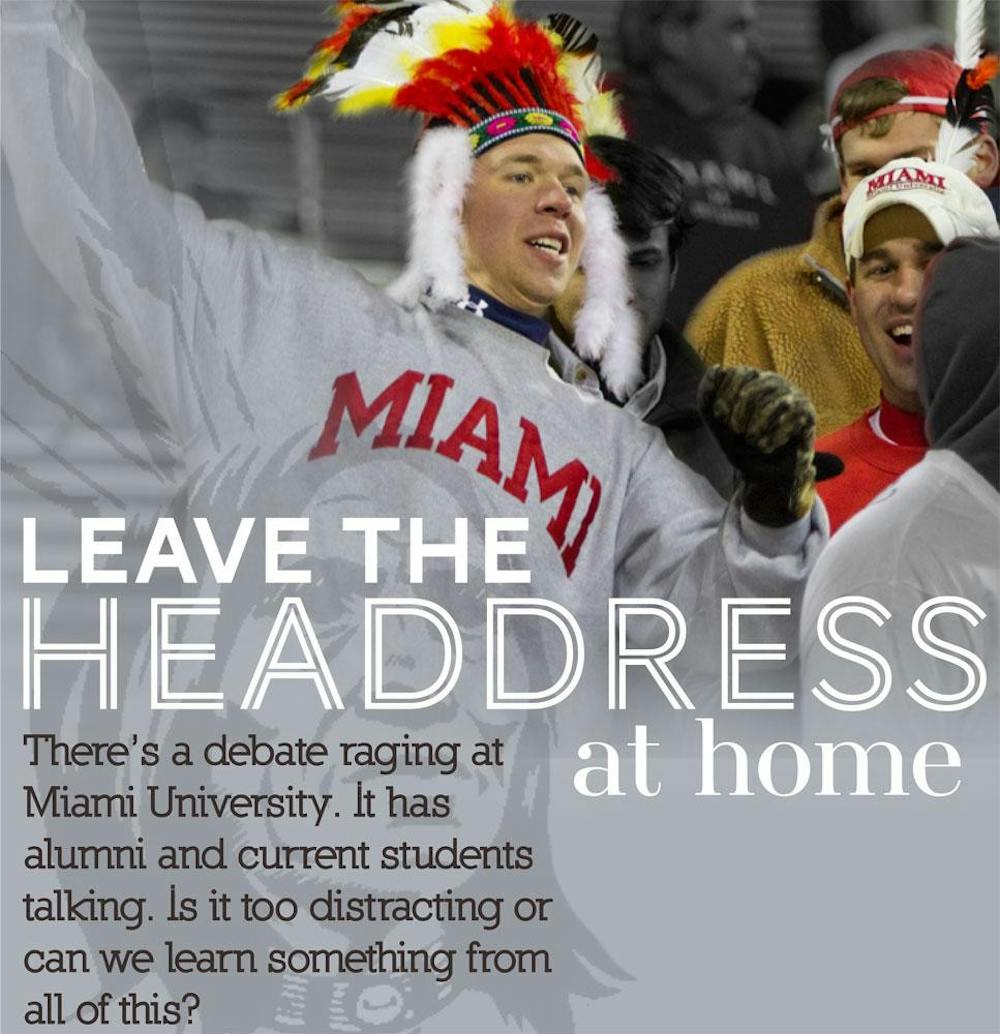

(SCOTT ALLISON | The Miami Student)
There's a debate raging at Miami University. It has alumni and current students talking. Is it too distracting or can we learn something from all of this?
It's tradition, songs and history of what used to be. The Miami University Redskins is a name that mostly alumni have held onto. They know how it used to be. They know better than anyone who is currently enrolled.
It has been 14 years since that mascot was eliminated, but some of the traditions linger on.
Students have picked up on these traditions, and now the discussion to eliminate them entirely has some up in arms.
"I don't see how they can do this," Miami University senior Brian Hackman said. "It's tradition. We've always had these things, and now they're telling us they want to take it away."
Students are confused. The images of the Redskin era still linger in sports arenas and are sold in the Miami University Bookstore, licensed by Miami University itself.
These images also send mixed signals to students. The mascot was eliminated at the urging of Miami University's namesake, the Miami Tribe.
"The Indian head (that is still on campus) does effect how students behave," Coordinator of Miami Tribe Relations Bobbe Burke said. "Maybe there is a mixed signal there."
While the mascot was officially eliminated in 1996 at the request of the Miami Tribe, the images still linger.
The time for change is now
Enjoy what you're reading?
Signup for our newsletter
The traditions associated with the Redskin name ring loudly throughout athletic events. Students shout and scream, they dance around in celebration, great things for an athletic program that lacks support from students.
University administrators are trying to channel that energy in a positive way.
In spring 2010, the Miami University women's swimming team received awards at the 2010 Mid-American Conference championship and student-athletes were photographed wearing headbands with feathers.
Those images made it onto the athletic department's website and immediately had people talking. It's an incident that was never publicized, and the images were removed immediately.
According to Burke, a meeting took place to discuss this incident. It was an issue because that is no longer how the university wishes to be seen.
Burke said she met with the athletics staff to discuss this. Band Director Stephen Lytle also joined the meetings after the discussions turned to the "Scalp Song," a tune played during athletic events to pump up the crowd.
At hockey games, students get involved in the tradition of waving goodbye to opposing players as they are sent to the penalty box. Just before the song ends, they start whooping, a sound made by bouncing your hand over your lips, mimicking a stereotypical Indian war cry.
It is an act that many Native Americans consider demeaning, but students at Miami consider to be a part of the school's tradition.
"It's not offensive," Hackman said. "We're not trying to hurt anyone when we do that stuff, it's just fun and helps us cheer on our team."
Despite the outcry from many students, the university has officially made the decision to end the "Scalp Song" and find something new that encompasses RedHawk tradition.
Hackman thinks the waving and whooping during the "Scalp Song" will continue even after the song is gone.
During a hockey game against University of Notre Dame earlier this year, students were still whooping even without the song, but that tradition may soon die away as well.
Another event that took place involved a student who was at a football game wearing an Indian headdress. The student was asked to take it off, which he did, but continued to put it back on.
After celebrating a touchdown and dancing around, the student was asked to leave.
Burke said this was an isolated incident and there was no policy against wearing a headdress.
Regardless of university policy, this incident further fueled the flames that drive debate surrounding the Redskin mascot.
The students at Miami University argue they are not trying to be offensive. Some have said they are honoring the Miami Tribe by doing these things.
Miami administrators understand the students' intentions, but according to Daryl Baldwin, director of the Myaamia Project and a member of the Miami Tribe, the traditions themselves are not healthy for a learning environment.
"It is my personal belief that Americans start shedding their stereotypes and start engaging with the Native American people," Baldwin said. "It doesn't allow us to progress and the imagery tends to hold us in the past."
Baldwin said the acts of whooping or wearing feather headdresses are not authentic to Miami Tribe culture.
"The ‘Scalp Song' is born out of a stereotype. It has nothing to do with us, but its presence keeps those stereotypes alive," Baldwin said.
Baldwin also said students who are engaging in these acts but choose not to learn more about tribal culture are in no way honoring them.
"That argument just doesn't stand," Baldwin said.
Burke, a 1970 graduate of Miami, said there was no such discussion on campus when she was a student. However, times have changed. A relationship with the Miami Tribe has been built.
"We want to represent this relationship in a respectful manner," Burke said. "Dressing up like, chopping like, whooping like, are all ways that we disparage the Indian people."
Earlier this year, a recent Miami graduate sent an e-mail to University President David Hodge with concerns about an "Indian Theme Party" that was to take place just before Thanksgiving break.
That student is no longer attending Miami and is enrolled at University of Kansas studying global indigenous nation studies and peace and conflict studies. According to her e-mail, she said she saw the event on Facebook and her sister was attending.
Administrators contacted the hosts of the event and the Facebook event was quickly removed. According to e-mails, administrators also requested the presence of several of the hosts to discuss the party.
According to the event's Facebook page, the party was a tradition dating back nearly 70 years. The event was reported to have never taken place.
According to Miami's mission statement, "Miami strives to cultivate an environment where diversity and difference are appreciated and respected."
Furthermore, a statement that ensures respect for all on campus reads, "We recognize that we must uphold and abide by university policies and procedures protecting individual rights and guiding democratic engagement. Any actions disregarding these policies and procedures, particularly those resulting in discrimination, harassment or bigoted acts, will be challenged swiftly and collectively."
Despite Miami's stated dedication to provide a healthy learning environment, the Redskin mascot was not removed until the Miami Tribe requested a change.
Hodge also said the image that lingers in athletic stadiums could soon be eliminated. The administration believes the old images no longer serve a purpose and do not reflect the university's values.
A poll recently conducted on The Miami Student website asked readers what they think should be done with the Redskin logo. An overwhelming majority, 81 percent, said they think the university should keep it.
A unique relationship
Miami University takes its name from a Native American tribe indigenous to the area around Indiana, Michigan and western Ohio. The Miami Tribe still exists as a sovereign nation in Oklahoma, recognized by the U.S. government. There are also tribe members living in Kansas and Indiana, but no longer around Miami University.
It wasn't until the 1970s that the chief of the Miami Tribe visited Miami University.
When Chief Forest Olds came to Miami University in 1972, he was asked what he thought about the use of the word Redskins. Earlier that same year, Miami University student senate unanimously voted to remove the Redskins mascot. Officially, there was nothing they could do.
Shortly after that resolution was passed, Miami University's president set up an ad hoc committee to investigate the use of the word and its impact.
Chief Olds wrote a letter to the university with his position on the issue, and it was a letter the university used for the next 20 years to defend the use of Redskins. That letter read:
"Know all peoples, that we of Miami blood are proud to have the name Miami Redskin carried with honor by the athletic representation of Miami University … We, The Miami Redskins of Indian blood, and our namesake, the Miami University Redskins, have a mutual and cherished heritage. May it be blessed by Moneto as long as the winds shall blow."
Chief Olds said he was okay with the use of Redskins and the mascot as long as it was presented in a respectful way.
This relationship is a unique one. Not many higher education institutions have a relationship with a Native American tribe, but many universities once carried Native American monikers and images.
According to Burke, since 1969 more than 600 schools and minor league sports teams have dropped their Native American mascots. Miami University is one of them, but it is one of the few to have a continued relationship with a tribe.
Neepwaantiinki — Partners in Learning
This relationship has helped set up the Myaamia Project, an organization on campus funded by Miami University and the Miami Tribe of Oklahoma. Its mission is to study and preserve the Miami Tribe culture and language and to further students' understanding of Miami culture.
According to Baldwin, the relationship is of special interest not only to the Miami Tribe, but should also be cherished by Miami University students as a unique learning experience.
"I think first and foremost the tribe feels very strongly about its positive relationship with Miami," Baldwin said. "How positive that relationship is how these two entities interact with each other."
The Myaamia Project focuses on education in the Miami Tribe and also among Miami University students. For example, a capstone course in spring 2009 allowed students to create an interactive language learning tool for Miami Tribe families.
This unique relationship has also set up a scholarship program for Miami Tribe citizens, allowing them to attend the university and also participate in these unique and culturally rich programs.
A unique learning experience
It wasn't until 1991 that anyone from the Miami Tribe came to study at Miami University. Since then, 70 Miami Tribe students have come to study there.
In fall semester 2010, there were 16 enrolled tribe students and one of them was studying abroad. They are a decided minority, making up less than half of one percent of all students on campus.
The Myaamia Project connects with these students every day and can be a deciding factor for tribe students to study at Miami University.
Andrew Strack is a member of the Miami Tribe of Oklahoma and from Indiana.
After graduating in 2007 with a degree in mass communication, Strack stayed in Oxford and joined the Myaamia Project as media specialist.
"The Myaamia Project was a significant part of why I came to Miami in the first place," Strack said.
According to Strack, Miami Tribe students meet once a week on campus, a tradition that began during his first year on campus, the 2003-04 academic year.
"That really helped reinforce our identity as a community," Strack said. "It certainly gives you a different perspective. There (are) not a lot of tribes in this area. People are always surprised if I identify myself as a Miami Tribe member."
While Strack said he doesn't bring it up too often, he has been asked to speak to classes.
"It's a part of my identity," Strack said.
Strack hasn't been completely free of issues regarding his heritage.
He said he has been verbally confronted about his heritage in an uncomfortable way.
"Typically it comes in form of ‘Did you get to go to school here for free?' and subsequently they would say ‘You don't look Indian,'" Strack said. "If that's what people latch onto without taking the time to learn about this or ask more questions about myself, then I don't have the time (for them)."
Other students have faced similar, but much more harassing comments since all of this talk about the "Scalp Song" and theme party came up.
According to Baldwin, Miami Tribe students on campus have been harassed verbally as a result of the recent headlines. While he declined to disclose details, he said a seemingly harmless comment can cut much deeper than intended.
"It's not just a surface thing for us. To me, it runs deeper. There's an underlying pain," Baldwin said of the discrimination Native Americans have faced in the U.S.
According to Baldwin, the stereotypical Redskins mascot oftentimes reinforces stereotypes that are not true and are not authentic to the Miami Tribe culture.
"The (Redskins) mascot in and of itself is rooted in misconception," Baldwin said.
Burke agreed the Redskin mascot only leads to negative stereotypes.
"Most people in this country have no idea the devastation the U.S. did to native people and their tribes," Burke said. "There's no way when we have someone dancing around on the sidelines that you can say ‘We're honoring you.'"
According to Baldwin, the stereotypes are hurtful and harmful no matter how innocent the intentions.
"Stereotypes distract students on this campus from understanding the true relationship and engaging with that," Baldwin said.
Baldwin said he would like to see the relationship between Miami University and the Miami Tribe continue to evolve and progress, and the only way that can be accomplished is by getting rid of demeaning traditions.
"There's a lesson in it all. We can learn a lot from old traditions," Baldwin said. "Because the mascot did go away, more meaning and positive things have come from it, like the Myaamia Project."
Just like scalping, these stereotypes are born out of Hollywood movies. Sensationalized for the big screen, many Native Americans never whooped and never scalped anyone. Many Native American tribes were actually quite peaceful.
Today especially there are no wars. No arrows are being shot between tribes.
"We carry the name of an Indian tribe and our relationship with them is important," Burke said. "Out of respect, we should not be stereotyping their culture or mocking them."

Whooping is a noise made by bouncing your hand over your mouth, mimicking a stereotypical Indian war cry. It is a tradition at hockey games that Miami University is trying to put to rest. (SCOTT ALLISON | The Miami Student)
Read More

Who’s who at MU: Head of special collections
By Shannon Mahoney | March 6, 2026If you’ve ever wanted to learn more about Miami University’s past, research the history of Western College or find the first copy of The Miami Student, chances are you’ve ended up at the university archives, a collection of Miami’s 217-year-long history. Behind this complex collection, one woman is at the center of it all: Jacky Johnson, head of special collections and archives.
How one professor and her classes are preserving Oxford’s Black history
By Sean Scott | March 20, 2024Jazma Sutton, an assistant professor of history, teaches The Black Midwest (HST 350Q) and Black Women in America (HST 450D) classes. In both courses, she has students working with the Smith Library of Regional History and Miami’s archives to document and preserve Black history in Oxford.
Miami faculty members recount Freedom Summer in new documentary
By Luke Macy | February 25, 2022After seven years of work, “Training for Freedom,” a documentary highlighting Oxford’s involvement in the Freedom Summer of 1964, premiered on PBS Western Reserve on Valentine’s Day.